
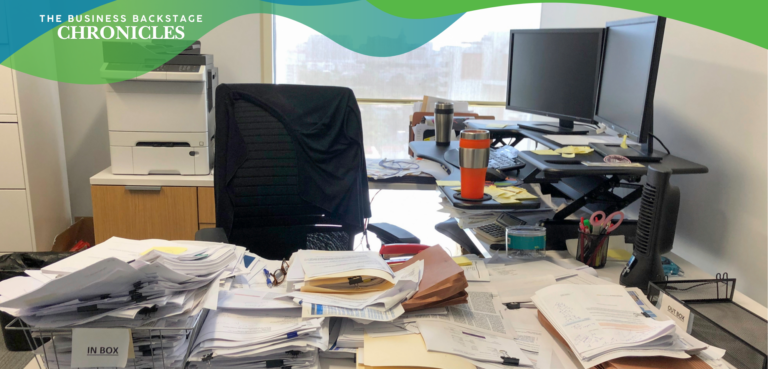
One of the stranger privileges of this work is the view it gives you.
In any given week, I might be working inside three or four different businesses. Different industries, different sizes, different problems on the surface. But after a while, the differences start to blur a little. Underneath the industry and the team size and the specific fire that needs putting out, a lot of the same things keep coming up.
I don’t mean this as a criticism. These patterns appear in good businesses run by capable people. They appear because running a business is genuinely hard, and certain things are hard in the same way for almost everyone.
Here’s what I keep noticing.
Most businesses are more dependent on one person than they realise
Usually the owner, sometimes a key team member. Occasionally both.
I see this clearly because I come in from outside. Information doesn’t get written down because the person who holds it is always available. Processes don’t get documented because they live in someone’s head and that’s been fine so far. Decisions don’t get delegated because it’s faster to just make them.
And it is faster, until that person is sick, or on holiday, or simply overwhelmed. Then everything either waits or falls apart slightly. Nobody planned for it to work that way. It just evolved.
The single most common thing I do in the early weeks with a new client is help extract what’s in someone’s head and put it somewhere it can live without them. Not because that person is going anywhere. But because a business shouldn’t depend on one person’s constant presence to function.
Growth tends to outpace systems
This is a good problem to have, and it’s still a problem.
A business builds its operations around a certain size. Then it grows. The systems that worked at five clients don’t quite hold at fifteen. The communication approach that worked with a team of two gets unwieldy at six. The tools that were “good enough” become the thing slowing everything down.
What I often see is a business that is functioning, but straining. Things are getting done, but with more friction than there should be. The friction has become so familiar that I often hear, “It’s just how things work.”
The moment a client tells me “we’ve always done it this way” is usually the moment worth pausing on.
There’s usually a gap between what gets said in meetings and what actually gets tracked
This one is quieter, but it comes up constantly.
Decisions get made. Good ones. And then nobody quite writes them down, or the notes get filed somewhere nobody goes back to, or the follow-through relies on whoever was in the room remembering what they agreed to do.
A month later, the same problem reappears. The same conversation happens. It looks like indecision or slowness, but it’s usually a documentation problem. The decision was made. It just didn’t stick anywhere.
I’ve started thinking of this as a memory problem for organisations. Not forgetting in a dramatic sense. Just the slow drift that happens when information doesn’t have a home.
People underestimate how much their inbox is costing them
Not just in time. In decision fatigue, in missed follow-ups, in the constant low-level noise of things waiting to be actioned.
A cluttered inbox is rarely an organisational problem. It’s a signal that something in the workflow doesn’t have a good home. A question that should have a documented answer, a type of request that should have a process, a conversation that should have happened somewhere with a thread rather than in a one-off email.
When I help a client get their inbox under control, the result is usually less about the emails and more about what we built around them.
The businesses that work best treat support as a partnership
This is the one I keep coming back to.
The clients who get the most out of working with a VA are not necessarily the ones with the most complex businesses or the largest budgets. They’re the ones who bring you in rather than handing tasks out. Who share context and ask for perspective. Who treat the relationship as collaborative rather than transactional.
Those relationships tend to compound. The longer they run, the more I can anticipate, the faster things move, the less that falls through. The trust built in the early weeks pays off for a long time after.
That’s the version of the work I find most interesting. Not just being useful, but being genuinely part of how a business thinks and runs. If you’re seeing any of this in your own business, that’s worth noting. Not as a reason to fix everything at once, but as a quiet signal that support, handled well, might do more than you’re expecting